



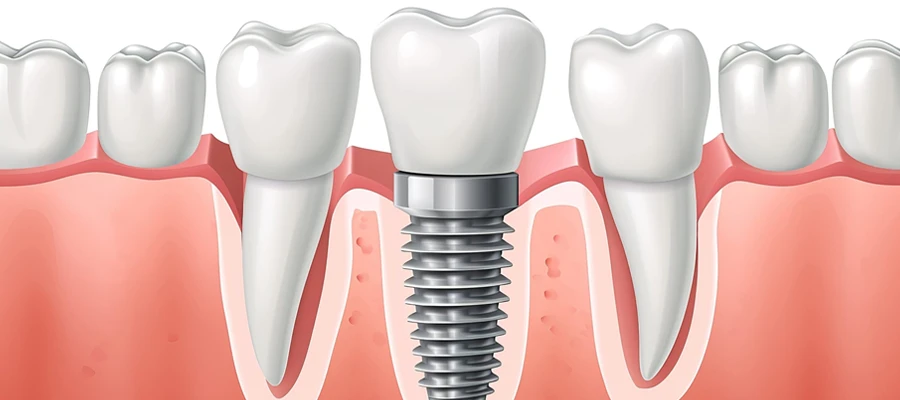
What is Implant Treatment?
The basis of this treatment is the creation of new teeth by using artificial tooth roots placed in the jawbone to replace missing teeth. Properly planned implant treatment can provide support for fixed or removable prostheses in different situations, from single tooth loss to multiple tooth loss.
Dental implants are mostly made from titanium or titanium-based materials. A connector is placed on the implant, which is then inserted into the jawbone, followed by a visible prosthetic tooth.
The process by which an implant biologically integrates with the bone is called osseointegration. This process usually takes longer than soft tissue healing and can take months, depending on individual circumstances.
Treatment is not simply about placing the implant screw. Bone structure, gum health, occlusion forces, and the design of the prosthesis are all parts of a long-term plan.
How is Implant Treatment Performed?
The first step involves an oral examination to assess the missing tooth area, gums, and jawbone. After completing the necessary imaging, the location, diameter, length of the implant, and the specifications of the prosthesis to be placed on it are planned for implant treatment.
During the surgical phase, the area is usually numbed with local anesthesia. A suitable socket is prepared in the jawbone, and the implant is placed in a controlled manner. If necessary, the area can be closed with sutures.
The implant may require a certain healing period to integrate with the bone. In selected cases, temporary prostheses or early loading options may be considered, but these are not suitable for everyone.
Once healing is complete, a permanent prosthesis is prepared using an impression or digital record. In the final stage, the occlusal relationship and cleanability are checked.
Who is a suitable candidate for dental implant treatment?
Individuals with one or more missing teeth and whose general health is suitable for surgical intervention may be evaluated for implant options. When sufficient bone and healthy oral tissues are present, implant treatment can be applied to different types of tooth loss in adults.
Eligibility is not determined solely by age. Factors such as complete jaw development, bone mass, gum health, and oral hygiene are evaluated together.
Uncontrolled diabetes, active periodontal disease, and certain systemic conditions can affect the treatment plan. Smoking can also pose a risk to healing and long-term surrounding tissue health.
Medications being used and past medical treatments should be shared before the procedure. Insufficient bone does not always mean implants cannot be placed; in some individuals, additional bone procedures may be considered.
In what situations are dental implants preferred?
In cases where a single tooth is lost, implants can be used to fill the missing space without relying on neighboring teeth for support. Under appropriate conditions, implant treatment can also help create implant-supported bridges for multiple missing teeth.
In cases of complete edentulism, it is not necessary to place a separate implant for each missing tooth. A certain number of implants can support a properly designed fixed or removable prosthesis.
In some individuals where removable dentures offer insufficient retention, support from implants may be considered. However, the number of implants and the type of prosthesis to be used should be determined according to the jawbone and occlusion characteristics.
If there is an active infection, uncontrolled periodontal disease, or inadequate oral hygiene, these problems may need to be managed first.
What are the advantages of implants in treating missing teeth?
One of the significant advantages is that in cases of single tooth loss, it is not necessary to reduce the size of adjacent healthy teeth for bridge support. Properly planned implant treatment can allow for an independent restoration in the missing tooth area.
In cases of multiple missing teeth, implants can support fixed bridges. In cases of complete edentulism, they can be used to increase the retention and stability of removable dentures.
The transfer of chewing forces to the bone allows for functional loading of the bone surrounding the implant. However, implant placement does not mean that bone loss will be completely stopped.
Implants also require regular maintenance. Unlike natural teeth, they don’t develop cavities, but peri-implant diseases, characterized by inflammation and bone loss in the surrounding tissues, can occur.
How is the oral and jaw structure evaluated before implant treatment?
During the planning phase, the missing tooth area, gums, adjacent teeth, and bite relationship are all examined together. For a safe implant treatment, the width, height, and distance of the jawbone to anatomical structures must also be evaluated.
In the upper jaw, the sinuses, and in the lower jaw, the nerve canal, can affect implant placement. In the anterior regions, in addition to bone structure, gum thickness and aesthetic expectations also become important factors.
Oral examination may be accompanied by imaging methods. Panoramic X-rays provide a general assessment, while three-dimensional imaging offers more detailed bone analysis in selected cases.
Planning isn’t just about determining whether the implant will fit into the bone. The final prosthesis’s position, chewing forces, and cleanability also influence the implant placement angle.
Why are panoramic X-rays taken before implant surgery?
Panoramic imaging can provide general information about the jaws, existing teeth, and surrounding key anatomical structures. Prior to planned implant treatment, panoramic X-rays can be used to roughly assess bone height and identify potential dental problems.
Impacted teeth, root remnants, or certain bone lesions can be evaluated on this image. Information about the general location of the sinuses and the mandibular nerve canal can also be obtained.
However, panoramic X-rays are two-dimensional. They do not adequately show bone width and the three-dimensional relationship of anatomical structures in all cases.
When more detailed measurements are required, three-dimensional imaging can be used. Which imaging method is necessary should be determined based on the anatomy of the implant site and the complexity of the procedure.
When is a CT scan necessary for implant treatment?
Dental tomography can be used in situations where three-dimensional evaluation of bone structure is required. Implant treatment, especially in areas close to anatomical structures, may require more detailed measurements of bone width and height.
Cone-beam computed tomography (CBT) allows for examination of the implant area in different planes. The position of the nerve canal in the lower jaw or the sinuses in the upper jaw can be evaluated in more detail using this method.
Three-dimensional imaging can be useful in complex cases involving bone grafting, sinus floor procedures, or the placement of multiple implants. CT data can also be utilized in guided surgical planning.
It cannot be said that a CT scan is automatically required in every implant case. The need for imaging should be determined based on clinical examination and available radiographic information.
How does jawbone density affect implant success?
Both the quantity and structural characteristics of bone can affect the initial stability of implant placement and the healing process. Therefore, when planning implant treatment, bone density, volume, and the support it will provide around the implant are evaluated together.
The initial stability of the implant may differ in lower bone density. In very dense bone, it is important to prevent the tissue from overheating during surgical preparation.
Bone density alone does not determine success. Factors such as surgical technique, implant placement, oral hygiene, smoking, and systemic health can also affect the outcome.
In the long term, it is necessary to keep the tissues surrounding the implant healthy. The initial presence of sufficient bone does not guarantee that no problems will develop in the surrounding tissues in the future.
How can you tell if there is enough bone for an implant?
Clinical examination and appropriate imaging techniques are used to assess the amount of bone in the implant area. For the planned implant treatment, not only the height of the bone but also its width and its relationship with surrounding anatomical structures are important.
Panoramic X-rays can provide information about general bone height. Three-dimensional CT scans can be used for situations requiring more detailed measurements.
The goal is to place the implant securely within the bone. Appropriate distance must be maintained from structures such as the nerve canal, sinus, and adjacent tooth roots.
Detecting insufficient bone does not necessarily mean that treatment is impossible. Different surgical options can be considered depending on the location and degree of bone loss.
Can implants be placed in patients with bone deficiency?
In some individuals with insufficient bone, additional surgical procedures can create adequate support for implants. Depending on the amount of bone, bone augmentation techniques may be considered before implant treatment or in the same procedure as implant placement.
Bone grafts and guided bone regeneration can be used in selected areas. Due to the location of the sinus cavity in the upper posterior jaw, some individuals may require sinus floor elevation procedures.
Not all bone deficiencies are treated in the same way. Whether the deficiency is horizontal or vertical, its size, and the condition of the soft tissue all affect the method that can be applied.
Additional bone procedures can prolong healing time and increase the scope of treatment. In some cases, evaluating alternative prosthetic options may also be more appropriate.
Should you choose an implant or a removable prosthesis?
The appropriate option is determined based on the number of missing teeth, bone condition, oral health, and the individual’s expectations. When sufficient anatomical conditions are met, implant treatment can provide the possibility of using fixed restorations or implant-supported removable dentures.
Traditional removable dentures do not require surgical implant placement and may be a suitable option for some people. However, retention and chewing sensation can vary from person to person.
Implant-supported solutions may provide more stable use, but require surgery, recovery time, and regular maintenance. Additional surgical procedures may also be necessary in cases of insufficient bone.
No single method can be said to be superior for everyone. Overall health, dexterity, hygiene capacity, and long-term care requirements should all be considered in the decision-making process.
Implant Treatment Prices 2026
Costs can vary significantly depending on the number of implants to be placed, the type of prosthesis to be made, and the current condition of the jawbone. Therefore, it is not possible to give a single standard figure for Implant Treatment prices in 2026 that will be valid for everyone.
Frequently Asked Questions
How long does it take to get a dental implant?
The surgical placement time for a single implant varies depending on the anatomical characteristics of the case and whether additional procedures are required. The duration of a simple implant treatment will not be the same as a procedure requiring bone grafting or other surgical intervention in the same session.
How many days of rest are needed after implant treatment?
The need for rest depends on the number of implants placed and the extent of the procedure. While some people can return to their daily lives quickly after limited implant treatment, bone grafting or multiple implant placements may require a longer recovery period.
When can I return to work after implant surgery?
Returning to desk work or low-exertion jobs is usually possible relatively quickly after limited procedures. However, as the scope of implant treatment expands, swelling, tenderness, and the need for rest may become more pronounced.
Is there any pain during the implant procedure?
Since the surgical area is usually numbed with local anesthesia, the aim is to keep significant pain under control during the procedure. Although a brief stinging sensation may be felt during the anesthesia administration, sensations such as pressure or vibration may be felt throughout the implant treatment.
Will there be a lot of pain after implant surgery?
It is possible to experience some degree of tenderness and pain after surgery. Generally, discomfort following implant treatment may be more pronounced in the first few days and is expected to decrease as healing progresses.
Is facial swelling normal after implant surgery?
Mild to moderate swelling following surgery may occur in the first few days. Edema may be more pronounced, especially after implant treatment involving multiple implants or bone procedures, and is expected to gradually decrease afterward.
Is it possible to perform a sutureless procedure after implant placement?
In suitable bone and soft tissue conditions, some implants can be placed through a small incision without raising a flap. In selected cases, implant treatment can therefore be completed without the need for sutures.