



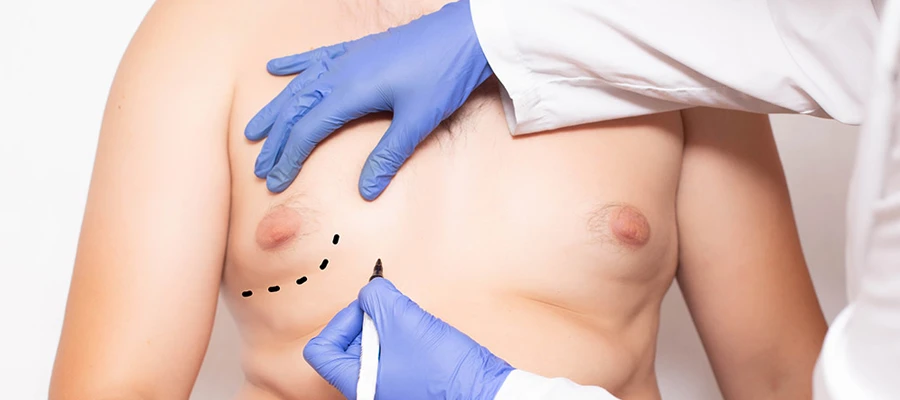
What is Gynecomastia?
Gynecomastia is a condition in men characterized by the benign enlargement of glandular tissue in the breast. Noticeable in the chest area, gynecomastia refers not only to fat accumulation but also, and specifically, to an increase in glandular tissue behind the nipple.
The enlargement may occur in one breast or both breasts. When both sides are affected, the sizes do not need to be exactly equal. Fullness, tenderness, or a firmer tissue felt around the nipple may be noticeable.
It can appear temporarily due to hormonal changes during puberty, or it can develop in adulthood for various reasons. Certain medications, hormonal disorders, and specific health problems are important in the evaluation.
Not all male breast enlargement is true gynecomastia. Pseudogynecomastia, caused by increased fatty tissue, can create a similar appearance.
What causes gynecomastia?
One of the key mechanisms affecting breast tissue is a change in the balance between estrogen and androgen activity. Gynecomastia, particularly during puberty and later life, can occur in association with natural hormonal changes.
Certain medications can also contribute to the growth of breast tissue. The use of anabolic steroids and various substances that affect the hormone system are considered possible causes.
Certain diseases affecting the testes, liver, kidneys, or thyroid can affect hormonal balance. However, it is not possible to identify a specific disease in every case.
In cases of newly developed or rapidly growing breast tissue, it is important to investigate the cause. Medical evaluation should be sought instead of discontinuing medications on your own.
Who gets gynecomastia?
This condition can occur at different stages of life, from the neonatal period to old age. Gynecomastia is particularly common during adolescence, a time of intense hormonal changes, and some cases may regress spontaneously over time.
Breast tissue enlargement can also develop in adult men. Changes in hormone levels and increased body fat percentage with age can affect the appearance.
The risk may differ for individuals taking certain medications or those with health conditions that affect the hormonal system. Anabolic steroid use is also an important consideration.
In overweight individuals, fat accumulation and glandular enlargement can occur simultaneously. Therefore, it is not always possible to distinguish between true breast tissue enlargement and fat accumulation based solely on external appearance.
What Causes Breast Enlargement in Men?
Male breast enlargement can result from an increase in glandular tissue, fatty tissue, or both. Differentiating gynecomastia from purely localized fat accumulation during examination is crucial for determining the appropriate treatment plan.
Hormonal fluctuations during puberty can temporarily enlarge glandular tissue. In adults, medications, hormonal system problems, and certain chronic diseases are evaluated.
Weight gain can make fat tissue in the breast area more prominent. In some people, both fat and actual breast tissue growth may occur along with weight gain.
Unilateral, firm, irregular, or rapidly growing masses should not be assumed to be merely a cosmetic problem. Further investigation is important when necessary.
What is the difference between gynecomastia and liposuction?
The main difference lies in the type of tissue causing the growth. Gynecomastia occurs when there is an increase in glandular tissue behind the nipple, while pseudogynecomastia is defined as an increase primarily in fatty tissue.
In true glandular enlargement, a denser or rubbery tissue may be felt under the nipple. In fatty tissue, the fullness may be more widespread and softer. However, self-assessment alone does not provide a definitive diagnosis.
In overweight individuals, these two conditions can occur together. In this case, losing weight may reduce the amount of fat, but it may not cause the glandular tissue to disappear completely.
Clinical examination plays a crucial role in differentiation. In suspicious cases, ultrasound or other diagnostic tests may be used.
What is true gynecomastia?
True gynecomastia refers to a condition where breast enlargement is primarily due to an increase in glandular breast tissue. The gynecomastia tissue felt behind the nipple may have a denser structure compared to the surrounding fatty tissue.
Hormonal changes can trigger the growth of this tissue. While some cases that appear during puberty may regress over time, long-standing glandular tissue may be more permanent.
True breast tissue growth is not only seen in overweight individuals. It can also develop in men with normal or low body fat percentages.
The need for treatment is determined by evaluating the duration, underlying cause, magnitude, and the physical or psychosocial distress experienced by the individual.
What is pseudogynecomastia?
Pseudogynecomastia is a condition in which breast enlargement in men is primarily caused by an increase in fatty tissue. While it may resemble gynecomastia in appearance, the underlying tissue structure is different.
Pseudogynecomastia can occur especially in people with high body fat percentage. Fat distribution in the breast area can also be influenced by genetic factors.
Weight loss can reduce total breast fat, leading to noticeable changes in breast appearance. However, it’s impossible to determine precisely how much fat will be lost from which areas.
Some individuals have both glandular tissue and fat deposits. Therefore, if a persistent bulge in the breast area continues after weight loss, an evaluation may be necessary to determine if there is true breast tissue enlargement.
What are the symptoms of gynecomastia?
Increased fullness around the nipple is one of the most frequently noticed findings. Gynecomastia, especially when developing behind the nipple, can be felt as a dense or rubbery tissue.
Some individuals may experience sensitivity or discomfort upon touch. These complaints may be more pronounced during periods of active tissue growth.
The enlargement can be unilateral or bilateral. The nipples appearing more prominent can also be aesthetically noticeable.
Nipple discharge, bleeding, hard and irregular lumps, skin retraction, or rapid growth should be evaluated differently from the routine presentation of gynecomastia. Appropriate medical examination is important in cases of these symptoms.
Can gynecomastia be unilateral?
Breast tissue growth may be noticeable only on the right or left side. While unilateral gynecomastia is possible, examination is particularly important in newly developing asymmetrical growths.
Sometimes, even though glandular tissue is present on both sides, one breast may be larger than the other. This may appear as a unilateral problem from the outside.
The characteristics of unilateral growth are assessed during examination. The softness and mobility of the tissue, its relationship to the nipple, and how long it has been present are important factors.
If there are findings such as a hard or irregular lump, nipple changes, discharge, or skin retraction, it should not be assumed that it is purely aesthetic gynecomastia. Necessary imaging and other investigations may be planned.
Can gynecomastia occur in both breasts?
It is possible for both breasts to be affected, and the enlargement does not have to be perfectly symmetrical. In a person with bilateral gynecomastia, the amount of tissue, shape, and degree of sagging may differ between the right and left breasts.
Bilateral growth spurts can occur during hormonal changes in adolescence. In adults, however, it is important to evaluate the underlying causes and medications being used.
During the examination, both breasts are examined separately. The amount of glandular tissue, fat content, and excess skin are compared.
Surgical planning takes existing asymmetry into account if necessary. While surgery can aim for a more balanced appearance, it cannot guarantee the complete elimination of natural left-right differences in the human body.
What are the different degrees of gynecomastia?
Classification can take into account breast size and accompanying excess skin. In clinical evaluation, gynecomastia can be seen in varying degrees, from mild localized enlargement to significant breast volume and sagging.
In mild cases, there may be limited tissue growth around the nipple. In more advanced cases, increased glandular tissue and fat can create a larger volume in the breast area.
Significant enlargement may be accompanied by excess skin and nipple deposition. These characteristics can influence the choice of surgical method.
The grading alone does not determine the treatment decision. Factors such as whether the tissue is glandular or fatty, skin quality, the individual’s anatomy, and expectations should also be considered in the treatment plan.
How is gynecomastia diagnosed?
Diagnosis usually begins with a combined evaluation of medical history and physical examination. The characteristics of the tissue behind the nipple are examined to differentiate gynecomastia from fat accumulation or other breast problems.
The timing of the onset of growth, any changes in development, and the presence of pain are all investigated. Medications, supplements, and substances that may affect the hormonal system are also considered.
If deemed necessary, laboratory tests related to hormones or organ function may be ordered. Imaging methods such as ultrasound may be used in certain cases.
Not everyone needs to undergo the same tests. If there is a suspicious mass on one side or unusual findings, a more thorough investigation is important.
How is a gynecomastia examination performed?
During a physical examination, the amount, consistency, and distribution of breast tissue are assessed. Whether the gynecomastia tissue located behind the nipple differs from the surrounding fatty tissue can be examined manually.
Asymmetry is investigated by comparing both breasts. Excess skin, nipple position, and rib cage structure are also evaluated.
During the medical history, weight changes, puberty, medications used, and possible hormone use may be inquired about. Further assessments related to the testes and hormonal system may be considered if necessary.
The purpose of the examination is not solely to plan cosmetic surgery. First, it is necessary to determine the nature of the growth and identify any possible medical causes that need to be investigated.
Gynecomastia Prices 2026
Treatment costs can vary depending on the structure of the breast tissue, the degree of growth, and the method used. Therefore, there is no single standard price for gynecomastia treatment in 2026 that can be applied to all patients.
Frequently Asked Questions
How is gynecomastia diagnosed?
A denser or rubbery tissue felt behind the nipple may suggest glandular growth. Especially when gynecomastia develops, a bulge, fullness, or sometimes tenderness around the nipple may be noticed.
External appearance alone is not sufficient for a definitive diagnosis. Fat deposits can create a similar appearance. Clinical evaluation of new, unilateral, or rapidly growing tissues is important.
How to differentiate between gynecomastia and liposuction?
In fat accumulation, breast tissue is generally more widespread and softer, while glandular growth may be felt more intensely under the nipple. During examination, the distinction between gynecomastia and pseudogynecomastia can be made by evaluating tissue characteristics.
Both conditions can coexist in the same person. It is not accurate to make a definitive distinction based solely on appearance or the individual’s own assessment of touch.
Can gynecomastia be treated with exercise?
Exercise can develop chest muscles and help reduce overall body fat. However, true glandular gynecomastia tissue cannot be directly eliminated through exercise.
Will gynecomastia completely disappear after losing weight?
Weight loss can reduce fat tissue in the breast area and improve the appearance, especially in pseudogynecomastia. However, glandular gynecomastia tissue may not completely disappear with weight loss alone.
Can gynecomastia be corrected without surgery?
The need for treatment depends on the cause of the growth and how long it has been present. Some cases of gynecomastia, particularly those developing during adolescence, may regress spontaneously over time.
How long does gynecomastia surgery take?
The duration of the operation varies depending on the surgical method used and the amount of tissue involved. A case requiring only limited liposuction will not be completed in the same amount of time as an advanced case requiring removal of glandular gynecomastia tissue and skin reshaping.
Is gynecomastia surgery painful?
The aim of the anesthesia used during surgery is to control pain. After the effects of the anesthesia wear off, tenderness, tightness, swelling, and bruising may occur in the areas where gynecomastia surgery was performed.
How many days of rest are needed after gynecomastia surgery?
The recovery period varies depending on the extent of liposuction, glandular tissue removal, and any possible skin excision. During the initial recovery period after gynecomastia surgery, it may be necessary to restrict movements that strain the chest area and avoid heavy lifting.
When can I return to work after gynecomastia surgery?
The return-to-work time is determined by the scope of the procedure performed and the individual’s profession. A person working at a desk may have a different work schedule after gynecomastia surgery than someone whose job requires heavy lifting or intense upper body movement.