



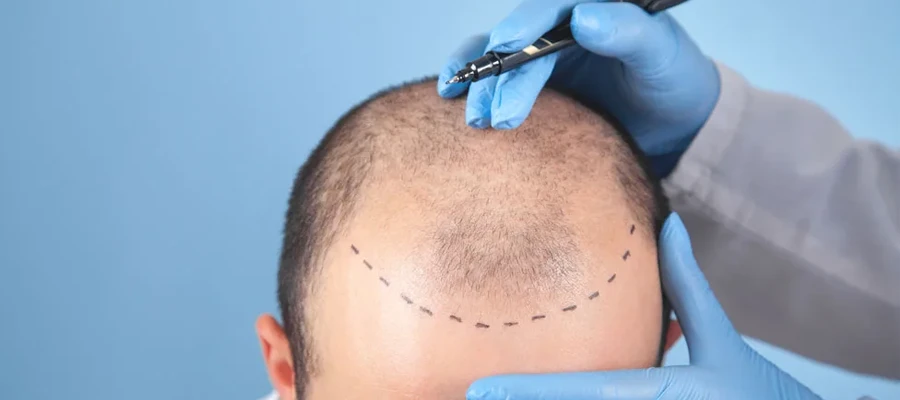
What is Hair Transplant?
Hair transplantation is a surgical procedure that aims to reduce the appearance of permanent hair loss by transferring hair follicles from dense, healthy areas to areas experiencing hair loss. When properly planned, hair transplantation can help recreate the hairline or make sparse areas appear denser by utilizing existing donor capacity.
During the procedure, follicular units from the back and sides of the head, which are more resistant to hair loss, are generally used. The harvested roots are placed in hairless or thinning areas, taking into account their natural growth direction.
Since no new hair follicles are created, the capacity of the donor area is important. The procedure distributes existing follicles from one area to another. Therefore, preserving existing hair and considering future hair loss are important parts of the planning, as well as achieving a natural look.
How is Hair Transplant Performed?
The procedure generally consists of preparing the donor area, extracting the hair follicles, and placing them in the designated recipient areas. Depending on the technique used, there may be some differences in the methods of extracting and placing the follicles during hair transplantation.
In the FUE approach, follicular units are extracted one by one using small-diameter punch instruments. In procedures called DHI, implanter pens can be used to place the extracted grafts. In both methods, preserving the viability of the hair follicles is important.
The direction, angle, and distribution of hair in the recipient area are planned in advance. The goal is to create an irregular and natural transition, especially in the frontal hairline. The procedure is usually performed under local anesthesia, and the total duration may vary depending on the number of grafts, the area to be treated, and the method used.
Who is a suitable candidate for Hair Transplant?
Individuals with permanent hair loss and sufficient donor capacity may be candidates for hair restoration after appropriate evaluation. Especially in androgenetic hair loss, hair transplantation can reshape the lost areas using existing healthy follicles.
Suitability is not determined solely by the size of the hairless area. Age, cause and rate of hair loss, donor density, hair strand characteristics, scalp health, and potential future hair loss must all be considered together.
Not all types of hair loss are suitable for transplantation. In cases of active alopecia areata, certain types of scarring alopecia, or uncontrolled scalp diseases, the underlying condition must first be evaluated. Furthermore, in individuals with insufficient donor areas, achieving the desired density with a single procedure may not be possible.
How is hair loss assessed before a Hair Transplant?
For successful planning, the cause, extent, and likelihood of progression of hair loss must first be assessed. At this stage, hair transplantation should be considered not merely a procedure to fill existing bald areas, but a long-term plan that also takes future hair loss into account.
During the examination, the hairline, crown area, hair thickness, miniaturization, donor density, and the overall condition of the scalp can be assessed. Family history of hair loss and changes in hair loss over time also contribute to the evaluation.
Sudden or widespread hair loss may require investigation into various causes. Hormonal problems, nutritional deficiencies, telogen effluvium, inflammatory diseases, and certain autoimmune conditions may necessitate different treatment approaches. Planning a hair transplant directly without determining the cause is not the correct approach in every case.
How is the donor area determined for Hair Transplant?
The donor area is defined as the region from which a sufficient number of healthy hair follicles with suitable characteristics can be safely harvested. In most cases, for hair transplantation, the more resistant hair follicles from the back and sides of the head are evaluated first.
Planning doesn’t just consider existing density. Hair thickness, the number of hairs in follicular units, long-term resistance to hair loss, and how the available grafts are distributed in the area are also important factors.
The donor area is not an unlimited resource. Removing too many grafts can create a sparse and irregular appearance in the posterior or lateral areas. Therefore, it is necessary to maintain safe donor margins. Not using the entire existing graft reserve in the first procedure, if a second procedure is possible in the future, can also be part of long-term planning.
Why is Donor Site Density Important?
Sufficient donor density directly affects the amount of grafts that can be transferred to the bald area and the visual coverage that can be achieved. During a planned hair transplant, it is necessary to preserve the natural appearance of the donor area, rather than simply extracting the highest possible number of grafts.
When hair density is low, it may not be possible to cover a large area of hairlessness with high density. In such cases, the hairline and visually prioritized areas can be planned more strategically.
Hair thickness, color, curl, and the number of hairs per follicular unit also affect the result. The same number of grafts does not create the same perception of density in every person. Therefore, instead of focusing solely on numerical graft targets, a balanced distribution should be created between donor capacity and the needs of the recipient area.
How many grafts are needed for a Hair Transplant?
The required number of grafts is determined individually based on the extent of hair loss, the desired density, donor capacity, and the distribution of existing hair. Therefore, there is no single graft number that applies to everyone for hair transplantation.
Limited receding hairline and advanced hair loss affecting the front, middle, and crown areas do not require the same number of grafts. Hair thickness and the number of hair strands within a graft can also alter the visual density.
A very high number of grafts does not always mean better results. Harvesting more grafts than the safe limit from the donor area can lead to permanent thinning. Therefore, when determining the required number of grafts, the current hair loss, the possibility of future hair loss, and the long-term preservation of the donor reserve should all be considered.
Which medications should be discontinued before Hair Transplant?
All medications being used should be shared with the physician before the procedure, and prescribed treatments should not be discontinued on personal decision. In particular, medications, supplements, and existing medical conditions that may affect bleeding tendencies should be evaluated together before hair transplantation.
Medications used to thin blood or certain treatments that affect clotting can increase bleeding during the procedure. Furthermore, suddenly stopping these medications can pose serious health risks for some individuals. Therefore, the recommendations of both the prescribing physician and the healthcare team performing the procedure should be considered together.
Vitamins, herbal products, and nutritional supplements should also be added to the list of products used. Pre-procedure preparation should be individualized; medical evaluation should be the basis for decisions regarding medication discontinuation timing or dosage changes, rather than general recommendations found online.
How long does a hair transplant procedure take?
The total procedure time can vary depending on the number of grafts to be transplanted, the method used, the characteristics of the donor area, and the size of the area to be treated. Hair transplant procedures treating large areas generally take longer than those with a limited hairline.
Preparation, local anesthesia, graft harvesting, recipient site planning, and root placement are all parts of the overall process. Harvesting the grafts individually and placing them in the correct directions takes time.
Therefore, it is not accurate to give a fixed procedure time that applies to everyone. While many procedures may take a few hours, high graft needs or technically more complex situations may require longer work. Careful processing of grafts and preservation of the donor area are more important than unnecessarily shortening the procedure time.
Is anesthesia used during hair transplantation?
Local anesthesia is often used to minimize discomfort during the procedure. This aims to significantly control pain in both the donor and recipient areas during hair transplantation.
A brief stinging, burning, or pressure sensation may be felt during the administration of anesthesia. Although the person may be able to perceive sensations such as touch, movement, or pressure throughout the procedure once the area is numb, significant pain is not expected.
In some procedures, additional relaxation methods may be considered depending on the patient’s medical condition and the procedure plan. The anesthesia approach to be used should be determined by considering the patient’s medical history, allergies, and medications being used. Informing the healthcare team if the numbness decreases or pain develops during the procedure allows for the administration of additional local anesthesia if necessary.
Is Hair Transplantation a Painful Procedure?
Local anesthesia helps control significant pain for most of the procedure. The first few minutes after anesthesia are particularly noticeable during the hair transplant process, with stinging or a brief burning sensation being more pronounced.
Remaining in the same position for extended periods can cause discomfort in the neck, back, or head for some individuals. Pressure or tenderness may also be felt in both the donor and recipient areas.
After the procedure, tenderness, tightness, or mild pain may develop as the effects of the anesthesia wear off. The degree of discomfort varies depending on the scope of the procedure and individual pain sensitivity. Pain that worsens or lasts longer than expected should be evaluated, especially if accompanied by significant redness, discharge, fever, or increased swelling.
What is the first day like after a hair transplant?
For the first 24 hours, both the transplant area and the donor area should be protected from physical contact as they are sensitive. Immediately after the hair transplant procedure, redness, mild swelling, tenderness, and small crusts may be seen in the transplanted area; this can be part of the early healing process.
It is important to avoid rubbing, scratching, or applying pressure to the transplanted roots. Following the instructions regarding the planting position can also help protect the transplanted area from unintentional contact.
Avoid strenuous physical activity and unnecessary touching of the procedure area on the first day. Medications should only be used as directed. Medical evaluation may be necessary if you experience significant bleeding, increasing pain, unusual swelling, discharge, or fever.
When should the first hair wash be done after a hair transplant?
The timing of the first wash may vary depending on the technique used and the aftercare protocol applied. In most cases, controlled washing can begin within the first few days after hair transplantation, but the timing given by the team that performed the procedure should be prioritized.
In the early stages, the goal is to clean the scalp while avoiding friction and unnecessary pressure on the newly implanted grafts. Strong water pressure, scratching with fingernails, or vigorous rubbing are not suitable for the newly transplanted area.
Forcibly removing the scabs should also be avoided. The washing method and frequency can be adjusted according to the healing phase. As the days progress, the bond between the grafts and the tissue strengthens, and the care routine gradually returns to normal. If scabbing lasts longer than expected, or if redness, discharge, and increased tenderness develop, evaluation may be required.
Hair Transplant Prices 2026
Treatment costs are not determined by a single figure; the extent of hair loss, donor capacity, and the specifics of the technique used can all affect the price. Therefore, when evaluating hair transplant prices in 2026, comparing prices solely based on the number of grafts is insufficient.
The size of the area to be transplanted is one of the key factors. Reshaping only the hairline does not constitute the same procedure as treating the front, middle, and crown areas together. Increasing the number of grafts required can change the procedure time and the scope of the application.
The use of methods such as FUE or implanter-assisted DHI can also affect planning. The duration and technical requirements may differ in procedures performed without shaving or with limited shaving.
Donor density, hair structure, previous hair transplants, existing scars, and the need for revisions can all alter the overall plan. Evaluating a donor area that has previously yielded a large number of grafts may require a different approach than evaluating a first-time patient.
Factors such as anesthesia, procedure time, preoperative evaluation, and postoperative follow-up should also be considered in the total cost. However, making a decision based solely on low price or the promise of a high graft yield is not appropriate. Since the donor area is limited, safe graft harvesting, natural hairline design, and consideration of future hair loss are important in long-term planning.
Frequently Asked Questions
At what age can hair transplantation be performed?
Age alone is not sufficient to determine the suitability of the procedure. Especially when planning a hair transplant at a young age, the type of hair loss, the rate of progression, family history, current hair density, and donor capacity should all be evaluated together.
If hair loss is progressing rapidly, a dense hairline created early on can leave unnatural gaps in later years. Therefore, instead of a fixed minimum age, long-term planning based on the characteristics of hair loss is more sensible.
How long does a hair transplant take?
The procedure time varies depending on the number of grafts, the area to be treated, the method used, and the characteristics of the donor area. A comprehensive hair transplant can take several hours, and the duration may be longer in procedures requiring a high number of grafts.
Preparation, anesthesia, extraction, and placement of grafts are all included in the total time. Therefore, it is not accurate to give a precise time estimate for everyone based solely on the number of grafts.
What is the maximum number of grafts that can be implanted in one session?
There is no single maximum number of grafts considered safe for everyone. The amount of hair transplant to be performed in a session should be determined according to donor density, safe harvesting area, hair characteristics, procedure duration, and the needs of the recipient area.
Obtaining the highest possible number of grafts is not always advantageous. Since excessive root harvesting can lead to permanent thinning in the donor area, preserving a long-term reserve should be a priority.
Would 3000 grafts be enough for a hair transplant?
While three thousand grafts can provide significant visual density in the front and middle areas for some individuals, they may not be sufficient for larger bald patches. The planned hair transplant outcome is determined not only by the number of grafts but also by the thickness of the hair strands, the number of hairs per graft, and the size of the area to be transplanted.
Therefore, the adequacy of 3000 grafts must be assessed on an individual basis. The same number can produce significantly different coverage in two people with different hair characteristics.
Who is a suitable candidate for a 5000 graft hair transplant?
The need for a high number of grafts usually arises in individuals with more extensive hair loss and sufficient donor reserves. Hair transplantation with approximately 5000 grafts can only be considered if the donor area can safely provide this amount.
Not every large opening justifies harvesting 5000 grafts. If donor capacity is insufficient, forcing the number can lead to significant thinning in the posterior and lateral regions. The safe number of grafts should be determined according to the individual donor characteristics.