



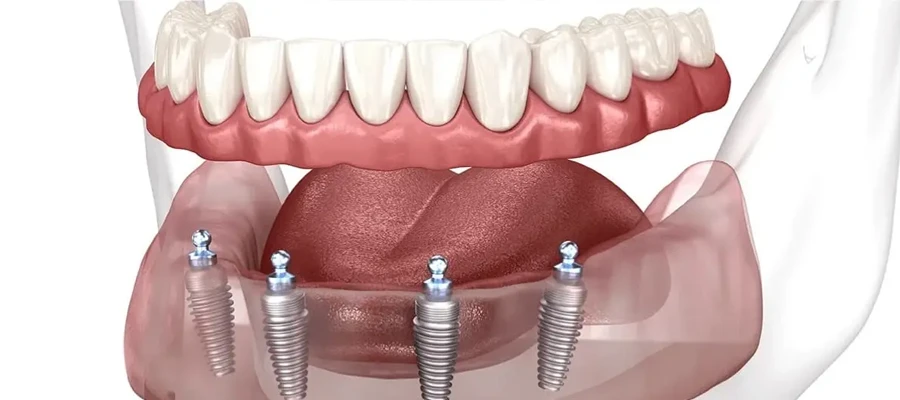
What is the All on Four Implant?
In jaws with complete or near-complete edentulism, the fixed full-arch prosthesis approach, usually supported by four implants, forms the basis of this treatment. Under suitable anatomical conditions, All on Four Implant is one of the treatment options that aims to support an entire dental arch with a smaller number of implants.
In planning, anterior implants are often placed more vertically, while posterior implants are placed at an angle according to anatomical structures. This aims to utilize existing bone and create a suitable support area for the prosthesis.
Four implants do not mean four teeth. These implants work together to support a single-piece or segmented full-arch prosthesis with multiple artificial teeth.
Not every edentulous individual is automatically suitable for this treatment. Bone structure, occlusion forces, overall health, and oral hygiene must be thoroughly evaluated.
How is All on Four Implant Treatment Performed?
Treatment begins with a detailed oral examination and imaging. After evaluating the jawbone and prosthetic requirements, the implant positions, angles, and the design of the prosthesis for All on Four Implant are planned.
If existing teeth that are unusable need to be extracted, this can be included in the treatment plan. During the surgical phase, implants are placed in the jawbone under local anesthesia. Posterior implants can be positioned at specific angles in suitable cases.
If sufficient initial stability is achieved, a temporary fixed prosthesis can be applied the same day or shortly thereafter. However, immediate weight-bearing is not suitable for every patient.
Once the implants have fully integrated with the bone, the permanent prosthesis phase begins. During this phase, occlusion, speech, cleanability, aesthetics, and chewing function are all evaluated together.
Who is All on Four Implant suitable for?
Adults who are completely edentulous or whose remaining teeth cannot be preserved long-term may be considered for this treatment. When adequate anatomical and health conditions are met, All on Four Implants can be an option for individuals seeking fixed full arch restorations.
Candidacy is not determined solely by the number of missing teeth. The amount and distribution of jawbone, gum health, bite forces, and the individual’s overall health are also important factors.
Uncontrolled systemic diseases, active oral infections, or poor oral hygiene can affect the treatment plan. Smoking can also pose a risk to healing and long-term tissue health around the implant.
Whether four implants are sufficient should be evaluated separately for each jaw. Some individuals may be better suited to a different number of implants or another full-arch treatment approach.
In which cases are All on Four implants preferred?
All on Four implants can be considered as a fixed prosthetic option in cases of complete edentulism or when a large portion of the remaining teeth cannot be preserved. Especially in individuals with suitable bone distribution, All on Four implants can be planned to create a prosthesis that supports the entire jaw.
Individuals who do not wish to use removable dentures can also be evaluated for suitability. In patients who are dissatisfied with the retention or movement of their current prosthesis, implant-supported options may provide a more stable structure.
In some cases where the amount of bone in the posterior region is limited, angled implant placement can help avoid anatomical structures. However, this approach does not eliminate every bone deficiency.
Treatment decisions should be made after imaging and clinical evaluation. A four-implant system should not be automatically assumed to be superior to alternative implant numbers.
How are All-on-Four implants applied in cases of complete edentulism?
In completely edentulous jaws, bone volume, gum structure, and the placement of the prosthesis are first evaluated. Once planning is complete, in the All on Four Implant approach, four implants are typically placed at designated points to provide support for a full arch prosthesis.
Angled placement of posterior implants can help utilize existing bone more effectively and increase support in the posterior region of the prosthesis. However, implant placement should be determined according to individual anatomy.
Temporary fixed teeth can be fitted early if initial stability is adequate. It is important not to apply excessive force to the temporary prosthesis during the implant integration period with the bone.
Once healing is complete, a permanent prosthesis can be prepared. In addition to the appearance of the new teeth, speech, chewing, bite, and suitability for daily cleaning should also be checked.
Can All on Four be performed on patients who are about to lose their teeth?
Full arch implant treatments may be considered if it is determined that the remaining teeth cannot be preserved in the long term. After a detailed examination, All on Four Implant may be an option for some individuals at risk of losing teeth due to advanced periodontal loss or significant structural problems.
However, just because some teeth can be extracted doesn’t mean all of them need to be removed. The condition of any preservable natural teeth should be carefully assessed.
The treatment plan takes into account the teeth to be extracted, existing infections, and the extent of bone loss. In suitable cases, extractions and implant placement can be performed in the same surgical procedure.
Active infection or advanced bone loss can alter the timing of treatment. The immediate application of a fixed temporary prosthesis also depends on the initial stability of the implants.
What are the advantages of All on Four Implant Treatment?
One of the main advantages of the method is that a completely edentulous jaw can be restored using a fixed prosthesis with a limited number of implants. In suitable individuals, All on Four Implants can provide a more stable chewing and usage sensation compared to removable full dentures.
Angled placement of posterior implants can help utilize existing bone more efficiently in some anatomies. This may reduce the need for extensive bone augmentation procedures in selected cases.
If adequate initial stability is achieved, early application of a temporary fixed prosthesis can also be a significant advantage. However, same-day fixed tooth use is not possible for everyone.
Using fewer implants can simplify the surgical plan in some cases. However, since the entire prosthesis depends on a limited number of implants, proper force distribution and regular maintenance are of paramount importance.
What are the disadvantages of All on Four Implant Treatment?
The fact that a full arch prosthesis is supported by a limited number of implants means that a serious problem with one implant can affect the entire prosthetic plan. Therefore, in All on Four Implant procedures, careful planning of implant placement and chewing forces is necessary.
Treatment involves surgery, and swelling, tenderness, or temporary discomfort may occur during the recovery period. Complications such as the implants not integrating with the bone are also possible.
The underside of the fixed prosthesis needs to be cleaned effectively on a daily basis. Poor oral hygiene can increase the risk of inflammation and bone loss in the tissues surrounding the implant.
Not every bone structure is suitable for a four-implant design. Additionally, conditions such as teeth grinding, high chewing forces, or significant bone deficiency may necessitate evaluation of different implant numbers and prosthesis designs.
How is the All on Four Pre-Implant Examination Performed?
During the initial examination, the existing teeth, gums, jawbone, and bite relationship are evaluated. In personalized All on Four Implant planning, not only the areas where the implants will be placed but also the future position of the prosthesis should be considered.
Teeth that cannot be saved and active infections are identified. If previously used prostheses are present, their occlusion and aesthetic characteristics can also be evaluated.
Medical history, medications used, and smoking habits—factors that may affect recovery—are questioned. The control status of systemic diseases can be important in planning the surgery.
Radiographic images support the evaluation of bone and anatomical structures. The examination can determine whether a four-implant approach is suitable or whether a different, full-arch plan would be safer.
Why is a CT scan performed before All on Four implant surgery?
Three-dimensional imaging helps to assess the width, height, and relationship of the jawbone to surrounding anatomical structures in detail. This information can be particularly important in All-on-Four implant planning, especially regarding the position and angle of posterior implants.
The sinus cavities in the upper jaw and the nerve canal in the lower jaw are structures that require careful attention. CT scans allow for the evaluation of the distance between these areas and the planned locations of the implants.
The distribution of bone volume in different areas of the jaw can also be examined in three dimensions. These images can be used in the process of digital implant planning or surgical guide preparation.
CT scans alone do not determine the treatment plan. Clinical examination, prosthesis design, and the patient’s overall health status should be evaluated in conjunction with the imaging findings.
How is bone structure evaluated for All on Four implants?
Bone assessment considers not only the total amount of bone but also how the bone is distributed throughout the jaw. For a successful All on Four Implant plan, the implants must be placed in secure positions within sufficient bone support.
Bone height and width can be assessed using three-dimensional images. Bone density and structural characteristics that can affect the initial stability of implants are also important in planning.
Bone loss in the posterior regions can be managed with angled implants in some cases. However, it should not be assumed that a four-implant approach is suitable for every case of severe bone deficiency.
Bone grafting or other surgical procedures may be necessary for some individuals. The number of implants used can also be adjusted according to bone structure, prosthesis design, and chewing forces.
Does the All on Four Implant Affect Speech?
The shape, thickness, and relationship of the new prosthesis to the tongue may initially cause temporary changes in speech. Especially after All on Four implants, during the adjustment period to the full arch prosthesis, the pronunciation of some sounds may sound different to the individual.
The anterior-posterior position of the teeth and the length of the front teeth play a role in the production of specific sounds. The relationship of the prosthesis to the palate or tongue area can also affect speech adaptation.
Most people can adapt their speech as they get used to their new teeth. However, in cases of significant and persistent pronunciation problems, the design of the prosthesis, tooth positions, and bite relationship should be re-evaluated.
Phonetic checks are important when preparing permanent prostheses. Aesthetic appearance and speech function should be planned together.
Will the appearance of the face change after All on Four implants?
Replacing lost teeth and supporting tissues with a suitable prosthesis can alter the support in the lip and lower face area. Especially in long-term edentulous individuals, the All on Four Implant prosthesis can provide increased support to some soft tissues that appear collapsed.
The extent of the change is not solely due to the implants themselves. The position of the prosthesis, the volume of the gum tissue, lip support, and the individual’s existing bone loss all play a role.
The goal is not to completely alter the face, but to adequately restore the support provided by missing teeth. Dentures that provide excessive lip support can create an unnatural appearance.
Therefore, the temporary prosthesis phase can be useful for aesthetic evaluation. Tooth length, lip support, and smile line can be checked before the permanent prosthesis.
All on Four Implant Prices 2026
The cost of treatment is not limited to the price of the four implants alone. When evaluating All on Four Implant prices in 2026, the surgical phase, temporary teeth, permanent full arch prosthesis, and any necessary additional procedures must be taken into consideration.
Frequently Asked Questions
How many teeth can All on Four implants replace?
Four implants are not used individually to replace four missing teeth. In a full arch All on Four Implant procedure, the implants collectively support a fixed prosthesis representing multiple missing teeth in a jaw.
Are four implants really enough for the All on Four implant procedure?
In some individuals with suitable bone structure and a correct prosthetic plan, four implants may be sufficient to support a full arch prosthesis. However, the number four in the All on Four Implant approach does not necessarily mean that four implants are the ideal number for every patient.
Can the All on Four implant procedure be completed on the same day?
The surgical procedure and, where appropriate, the application of a temporary fixed prosthesis can be performed on the same day. However, it is not accurate to say that all stages of All on Four Implant treatment are completed on the same day.
With All on Four implants, are teeth fitted on the same day?
In suitable cases where sufficient initial stability is achieved, a temporary fixed prosthesis can be placed on the implants on the same day or shortly thereafter. Therefore, immediate loading may be possible for some individuals with All on Four Implant treatment.
How long does All on Four implant treatment take?
The length of the surgical procedure varies depending on the number of teeth to be extracted, the bone structure, and any additional surgical requirements. The All on Four Implant procedure performed on a single jaw does not require the same duration as treating both jaws simultaneously.
Is the All on Four implant procedure painful?
Since the surgical area is usually numbed with local anesthesia, the aim is to keep significant pain under control during the procedure. After anesthesia, sensations such as pressure or vibration may be felt during the All on Four Implant placement.
How many days of rest are needed after an All on Four implant procedure?
Rest requirements vary depending on the scope of the surgery, the extractions performed, and the individual’s recovery rate. Particularly after extensive All-on-Four implant procedures, limiting physical activity and protecting the surgical site may be necessary in the first few days.