



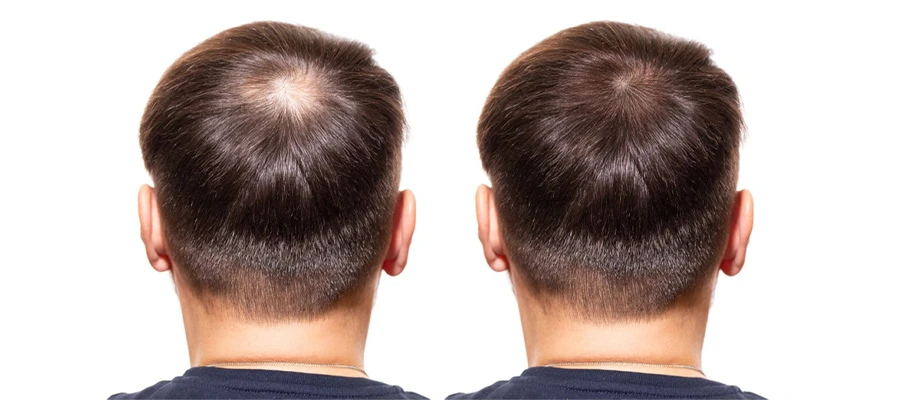
What is FUE Hair Transplantation?
The fundamental characteristic of this method is the extraction of hair follicles one by one as follicular units from the donor area. A properly planned FUE hair transplant aims to place the harvested grafts in bald or thinning areas, taking into account natural angles and directions.
Follicular units are usually taken from hairs on the back and sides of the head that are more resistant to hair loss. Small-diameter punches are used to extract the roots. Unlike the FUT method, a long strip of tissue is not removed from the scalp.
The FUE procedure is not completely scarless. Numerous small, scattered pinpoint scars may form in the donor area, and their visibility can vary depending on hair length, skin characteristics, and the amount of graft taken.
The procedure does not produce new hair follicles. Since it transfers existing donor follicles to a different area, preserving donor capacity in the long term is important.
How is FUE Hair Transplantation Performed?
Before the procedure, the extent of hair loss, the donor area, and the hairline to be treated are evaluated. Following local anesthesia, follicular units selected for FUE hair transplantation are carefully separated from the surrounding tissue using appropriately sized punch tools.
The freed grafts are collected individually and can be classified according to their characteristics. Protecting the roots under suitable conditions while they are outside the body is important for maintaining their viability.
Channels can be prepared in the recipient area according to the planned placement, and grafts are transferred to these areas. There may be some differences in the procedure stages depending on the placement technique used.
Following the natural direction of hair growth is especially important at the hairline. The goal should be to create a balanced and long-term distribution while protecting the donor area, rather than maximizing the number of grafts.
Who is suitable for FUE hair transplantation?
Individuals with permanent hair loss and sufficient donor capacity may be candidates for this method after appropriate evaluation. Especially in androgenetic hair loss, FUE hair transplantation can be considered for the purpose of recreating the hairline or increasing the density of sparse areas.
Candidacy is not determined solely by the extent of the baldness. The cause of hair loss, the rate of progression, age, family history, hair thickness, and the long-term condition of the donor area should all be considered together.
Direct hair transplantation may not be suitable for active alopecia areata, some types of scarring alopecia, and uncontrolled scalp diseases. In cases of sudden, widespread hair loss, the underlying cause should be investigated first.
In cases where donor reserves are limited, it may not be possible to cover large areas with high density. In such situations, priority areas can be identified and a more strategic plan can be developed.
What are the advantages of FUE hair transplantation?
Extracting follicular units individually eliminates the need to remove a long strip of skin. Thanks to this feature, FUE hair transplantation leaves numerous small, scattered, pinpoint scars in the donor area instead of a linear FUT scar.
One of the significant advantages is that the points from which the roots will be taken can be distributed within a wide, safe donor area. Proper planning can help reduce the risk of excessive thinning in a particular area.
FUE can be used in areas of varying degrees of hair loss, and the resulting grafts can be applied using various placement methods. The hairline, temples, mid-range, or crown area can be targeted according to need.
However, the advantages of this method are not limitless. For a natural result, hairline design, graft preservation, proper orientation, and safe donor management are at least as important as the root extraction technique.
What are the disadvantages of FUE hair transplantation?
Extracting individual follicular units is a time-consuming process requiring careful execution. Especially in cases requiring a high number of grafts, FUE hair transplantation can be lengthy and may require working on a large donor area.
The procedure is not scarless. Each removal point creates a small healing area, and pinpoint scarring may be noticeable in some individuals using short hair.
Overuse of the donor area is another significant risk. Removing too many grafts can lead to permanent thinning, uneven density, and a moth-eaten appearance.
Damage to follicles during extraction can also affect graft quality. Punch diameter, extraction technique, hair follicle orientation, and how grafts are protected during the procedure all play a role in the outcome. Therefore, a high graft count alone is not an indicator of success.
In which types of hair loss is FUE hair transplantation preferred?
Surgical hair restoration may be considered in cases of permanent follicle loss where safe donor hair is available. FUE hair transplantation, most commonly used for androgenetic hair loss, can be applied to reduce thinning in suitable individuals in the frontal, temple, mid-scalp, or crown areas.
In some traumatic or surgical scars, hair transplantation may be considered depending on the characteristics of the surrounding tissue. However, blood supply and graft retention in scar tissue may differ from that in normal scalp tissue.
Not all types of hair loss require transplantation. In temporary hair loss such as telogen effluvium, the cause must first be investigated. In active alopecia areata and some types of scarring alopecia, disease activity should also be evaluated.
Hair transplantation performed without a proper diagnosis will not stop ongoing hair loss and may create an uneven appearance in the long term.
How is the donor area determined for FUE hair transplantation?
When selecting a donor area, regions with hair that is more resistant to hair loss in the long term are evaluated. For most people, the safe donor areas on the back and sides of the head are used as the primary source for FUE hair transplantation.
Looking only at current density is not enough. The number of hairs per follicular unit, the thickness of the hair strands, miniaturization, and the likelihood of future hair loss should also be examined.
Hair follicles taken outside the safe donor margin may be more prone to shedding in later years. Additionally, removing an excessive amount of grafts from the same small area can lead to visible thinning.
The possibility of a second procedure in the future should also be considered. Avoiding unnecessary depletion of the donor reserve in the first session helps preserve healthy follicles that can be used in cases of progressive hair loss.
How is a hair analysis performed before FUE hair transplantation?
The initial assessment examines the cause, distribution, and changes over time of hair loss. Before the planned FUE hair transplant, both the recipient area and the donor area are evaluated separately to create a feasible long-term plan.
In the donor area, density, hair diameter, follicular unit structure, and miniaturization can be considered. In the recipient area, the location of existing hair, the extent of the baldness, and the risk of future hair loss are evaluated.
Age, family history, and previous hair treatments can also contribute to the planning process. In cases of sudden or widespread hair loss, it may be necessary to investigate the underlying causes.
Hormonal problems, nutritional deficiencies, inflammatory diseases, or different types of alopecia can alter the course of hair loss. Therefore, hair analysis is not simply about calculating how many grafts are needed.
How many grafts are needed for FUE hair transplantation?
The required number of grafts varies depending on the extent of hair loss, existing hair density, and the desired visual coverage. Therefore, there is no fixed or ideal number of grafts for everyone in FUE hair transplantation.
A minor hairline correction and combined treatment of the front, middle, and crown areas do not require the same number of grafts. Hair thickness and the number of hairs per follicular unit also affect visual density.
Donor capacity is one of the key factors that determine the limits of the calculation. The theoretical amount of graft required by the recipient area may exceed the amount that can be safely obtained.
In such cases, visually appealing areas can be selected. Preserving a sufficient donor reserve for future hair loss is also part of the planning.
How are FUE hair transplant grafts harvested?
Follicular units are primarily evaluated based on their natural direction of growth in the donor area. After local anesthesia, the area around the selected follicles for FUE hair transplantation is carefully freed using small-diameter punch tools.
The goal is to separate the follicular unit from the surrounding tissue while minimizing damage to the hair follicles. Ensuring the punch angle aligns with the direction of the hair beneath the skin can help reduce the risk of cutting the root.
The freed grafts are carefully removed using appropriate instruments. They can then be examined and classified according to their follicular characteristics.
The hair follicle harvesting process should ensure even distribution throughout the donor area. Extracting a high density of grafts from the same area can lead to visible thinning, so the locations from which the grafts are taken are as important as the total number of grafts.
How are hair follicles protected during FUE hair transplantation?
The follicular units removed from the body must be protected from physical damage, drying, and unsuitable conditions. Careful handling and proper preservation of FUE hair transplant grafts throughout the procedure are crucial for their viability.
Unnecessary mechanical pressure should not be applied to the root portion of the grafts. Delicate work during the extraction, classification, and placement phases can reduce the risk of damage to follicular structures.
The time spent outside the body and storage conditions should also be considered. It is important that grafts are not left unnecessarily long and are kept moist with appropriate solutions.
Successful root preservation does not depend on a single factor. The harvesting technique, graft manipulation, waiting conditions, and the process of placement in the recipient area all affect the outcome.
What causes unsuccessful FUE hair transplants?
The failure to achieve the expected density cannot be attributed to a single cause. Inadequate donor evaluation, poor hairline planning, graft damage, or ongoing natural hair loss can all contribute to an unsatisfactory outcome from FUE hair transplantation.
Damage to the roots during extraction or improper preservation can affect graft development. Incorrect angles and directions during placement can also create an unnatural appearance, even if the hair grows.
Overuse of donor area can lead to permanent thinning in the back of the head. Continued hair loss over time can also create gaps between transplanted and natural hair.
Early assessment of the results can be misleading. Transplanted hair may shed initially, and it takes months for new growth to become noticeable.
Is it possible to perform correction procedures after FUE hair transplantation?
Insufficient density, uneven hairline, or localized gaps can be re-evaluated after adequate healing. If sufficient donor reserve is available, it may be possible in some individuals to have additional grafts placed to improve upon the previous FUE hair transplant result.
Correction doesn’t simply mean increasing density. Unnatural hair directions, an excessively low hairline, or overused donor areas may require more complex planning.
The results of the initial treatment should not be definitively assessed before sufficient time has passed. Hair regrowth and thickening can continue for months.
Donor capacity should be recalculated before revision. Pinpoint scarring from the previous procedure and existing hair density may limit the amount of new grafts that can be safely harvested.
Is it possible to have a second FUE hair transplant?
A second procedure may be considered if sufficient healthy follicles remain in the donor area and the recipient area requires additional grafts. Having undergone previous FUE hair transplantation alone does not preclude a new procedure.
Some people may prefer a phased treatment plan instead of closing the entire wide bald area in the first application. In others, the shedding of natural hair in later years may create new bald patches.
Each procedure uses a specific number of follicles from the donor reserve. Therefore, the number of safe grafts that can be harvested in the second or subsequent sessions may gradually decrease.
The donor distribution from the previous procedure must be evaluated. A balance must be struck between the graft requirement and the remaining reserve, as harvesting dense roots again from excessively thinned areas could further worsen the appearance.
FUE Hair Transplant Prices 2026
The cost is determined by considering the extent of hair loss, the number of grafts needed, the characteristics of the donor area, and the technical scope of the procedure. Therefore, there is no single standard price for FUE hair transplantation in 2026 that can be applied to everyone.
Frequently Asked Questions
How long does an FUE hair transplant take?
The total procedure time depends on the number of grafts, the characteristics of the donor area, and the size of the area to be transplanted. While a comprehensive FUE hair transplant can take a few hours, the procedure may take longer if a high number of grafts are needed.
How many grafts can be used in an FUE hair transplant?
The safe number of grafts that can be harvested in a single session varies from person to person, and there is no universal maximum number. During a planned FUE hair transplant, donor density, hair thickness, safe harvesting area, and future needs should all be considered together.
Does FUE hair transplantation hurt?
Since the procedure is mostly performed under local anesthesia, the aim is to control significant pain. Although a brief stinging or burning sensation may be felt during the application of the anesthesia, the most noticeable sensation throughout the FUE hair transplant is touch and pressure.
In FUE hair transplantation, are the hairs completely cut off?
Complete shaving is not always mandatory. When graft needs and hair structure are suitable, FUE hair transplantation can be performed with limited shaving or, in selected cases, with an unshaven approach.
How many days of rest are needed after an FUE hair transplant?
The time it takes to return to daily life varies depending on the scope of the procedure and the individual’s activity level. It is especially important to protect the FUE hair transplant area from friction, impact, and intense physical activity during the first few days.
When can I return to work after an FUE hair transplant?
The time required to return to work depends on the physical demands of the profession and the course of early recovery. While those with desk jobs may be able to return to work sooner physically after FUE hair transplantation, redness and scabbing may remain visible for a while.