



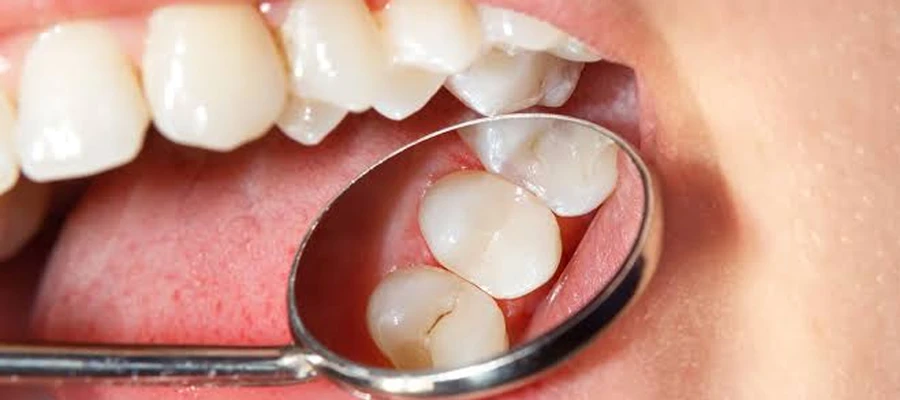
What is a Dental Filling?
Dental fillings are the process of restoring tooth tissue lost due to decay, fracture, or wear using a suitable restorative material. A properly planned dental filling aims to restore the tooth’s shape, chewing function, and contact with neighboring teeth as much as possible.
During the procedure, damaged or decayed tissue is removed as needed. The prepared area can be filled using composite, amalgam, or other restorative materials. In cases of greater tissue loss, inlay and onlay restorations prepared in the laboratory or using digital methods can be considered.
The type of filling is determined by the tooth’s location, the amount of remaining healthy tissue, chewing forces, and aesthetic requirements. Not every damaged tooth can be treated with a filling alone. Deep cavities, large fractures, or problems affecting nerve tissue may require different treatments.
Why are dental fillings done?
Replacing lost tooth tissue and preventing further damage are among the primary goals of restorative treatment. After the decay is removed, a filling closes the resulting gap, helping the tooth regain its functionality.
Fillings aren’t only done because of decay. Minor fractures, abrasions, and some deformities can also be repaired with appropriate restorative materials.
The goal of treatment is to preserve as much healthy tooth tissue as possible. Depending on the extent of the damage, either direct composite application or restorations prepared in a laboratory may be preferred.
Untreated tooth decay can progress to deeper tissues over time. However, fillings do not guarantee that the tooth will not decay again in the future. Oral hygiene and regular check-ups are important for long-term success.
When are dental fillings necessary?
When irreversible tissue loss occurs in a tooth due to decay, restorative treatment may be necessary. Based on the examination results, dental fillings may be considered for small to medium-sized cavities, as well as some fractures or wear.
A fractured or misaligned old filling can also necessitate a new restoration. If decay develops again around the filling, the existing restoration may need to be replaced.
Not every discoloration or surface stain means decay. Therefore, the decision to fill a tooth should not be made solely based on its appearance.
If the decay has progressed to the nerve of the tooth, root canal treatment may be considered. If there is very little healthy tooth tissue remaining, a more extensive restoration may be needed instead of a filling.
How is tooth decay treated with fillings?
The first stage of treatment involves assessing the location and extent of the decay. In suitable cases, during the dental filling process, the decayed and irreversibly damaged tissues are removed in a controlled manner.
If necessary, the treatment area is numbed using local anesthesia. After the prepared area is cleaned, the selected restorative material is applied to the tooth.
If composite is used, the material is usually placed in layers and hardened with special light. Afterwards, the shape of the filling, its contact with the adjacent tooth, and its relationship with the opposing teeth during chewing are checked.
In deep caries, proximity to the nerve is particularly important. If the pulp tissue is irreversibly damaged, filling alone may not be sufficient, and different treatments may be required.
Can broken teeth be filled?
Some small to medium-sized tooth fractures can be repaired with restorative materials. If sufficient healthy tissue remains, a dental filling can help restore the shape and function of the fractured section.
Composite materials are frequently considered for front teeth due to their aesthetic qualities. For back teeth, however, the size of the fracture and chewing forces influence the method to be applied.
If the fracture extends towards the root of the tooth or affects a large portion of the tooth, a simple filling may not be sufficient. Onlays, crowns, or other restorative options may be considered.
The nerve in the tooth can also be damaged after trauma. Therefore, in fractured teeth, especially those with pain, discoloration, or mobility, repairing only the visible part should not be sufficient.
Can worn teeth be repaired with fillings?
When the extent and cause of wear are appropriate, lost tooth tissue can be restored with restorative materials. Especially in cases of limited tissue loss, dental fillings can be used to recreate the shape of the tooth and some of its functional contacts.
Wear can be related to teeth clenching, grinding, acid exposure, or mechanical factors. Simply filling the worn area may not be sufficient in the long term if the underlying cause persists.
In cases where multiple teeth are significantly worn down, the bite relationship should also be evaluated. Extensive tissue loss may require more extensive restorative treatments.
The durability of the filling material is affected by chewing forces. Therefore, the cause of the wear should be determined as much as possible before any repair is made.
Who is a suitable candidate for dental fillings?
Individuals with tooth tissue loss due to decay, limited fracture, or wear may be evaluated for restorative treatment. Dental fillings can be applied to individuals of all ages, from children to adults, provided sufficient healthy tooth tissue remains.
Suitability is not solely dependent on age. The depth of the decay, the condition of the tooth nerve, and the amount of remaining tooth tissue all influence the treatment decision.
In cases of very large tissue loss, it is possible that classic fillings may not provide sufficient durability. In such cases, different restorations such as inlays, onlays, or crowns can be considered.
If there is irreversible pulp damage in the tooth, root canal treatment may be necessary. Serious problems in the root or surrounding supporting tissues can also change the treatment approach.
How is a pre-dental examination performed?
During the examination, the surface of the tooth, any existing decay or fracture, and the surrounding tissues are evaluated. Understanding the extent of the damage and its relationship to the tooth nerve is important before any dental filling is applied.
If there are old fillings, their marginal adaptation and possible fractures are checked. It may not always be possible to detect cavities in contact areas with adjacent teeth through visual examination alone.
If necessary, pulp assessments such as cold tests can be performed. If there is pain during biting, cracks or other problems may also be investigated.
The examination will determine if the filler is sufficient. If there is more extensive tissue loss or nerve involvement, different treatments may be planned.
Is an X-ray necessary before a filler treatment?
Not every filling requires an X-ray. However, in areas that are difficult to assess visually, radiographic images can provide important information about the depth and location of decay before a planned dental filling.
Appropriate intraoral radiographs can be useful in identifying cavities, especially those between teeth. In cases of deep cavities, the proximity to nerve tissue can also be assessed radiographically.
Some problems that may have developed under or around old fillings can be better examined with imaging. However, X-ray findings do not replace clinical examination.
The need for imaging should be determined based on the condition of the tooth and the available clinical findings. It is important to avoid unnecessary radiographic examinations.
What are the different types of dental fillings?
Restorative materials can be divided into different groups according to their areas of use, aesthetic properties, and application methods. The choice of dental filling is determined by considering the position of the tooth, the extent of tissue loss, and chewing forces.
Composite fillings can be used in both the front and back of the tooth area because they are tooth-colored. Amalgam fillings are metal-based and have been used as direct restorative materials for a long time.
For larger tissue losses, indirect restorations such as inlays or onlays may be considered. These can be made from ceramic or other suitable materials.
No single type of filling is the best option for all teeth. The remaining healthy tooth tissue, moisture control, aesthetic expectations, and the forces the restoration will be subjected to all influence material selection.
What is Composite Filling?
Resin-based restorative materials that can be prepared in tooth color are called composites. Used for dental fillings in areas where aesthetic appearance is important, composites can be bonded to natural tooth tissue using appropriate techniques.
During the procedure, the tooth surface is prepared and bonding systems are used. The composite material is usually placed in small layers and cured with light.
The availability of color options helps to match natural teeth. However, composite can wear down, break, or show surface discoloration over time.
The lifespan of a restoration depends on the size of the filling, the position of the tooth, chewing forces, and oral hygiene. Composite restorations can be repaired or replaced if necessary.
What is White Filler?
In everyday usage, the term “white filling” usually refers to composite restorations that can mimic the natural tooth color. Dental fillings chosen for aesthetic purposes can be made to blend seamlessly with the surrounding tooth tissue using various color and transparency options.
These materials are not only used on front teeth. When the appropriate conditions are met, they can also be used to restore cavities in back teeth.
Just because it’s tooth-colored doesn’t mean the restoration will be completely invisible. The size of the filling, the color of the tooth, and the application technique all affect the aesthetic result.
White fillings may show superficial discoloration or wear over time. Regular oral care and check-ups help monitor the condition of the restoration.
What is amalgam filling?
Amalgam is a restorative material formed by combining a metal alloy with mercury in specific proportions. This type of dental filling, used for many years, was widely preferred in the past, especially in back teeth, due to its durability.
Amalgam does not resemble the color of natural tooth tissue. Therefore, its appearance can be a disadvantage in areas where aesthetic expectations are high.
Existing, sound amalgam fillings do not automatically need to be replaced simply because of their color. The decision to replace them should be made considering the condition of the restoration, caries, fractures, and other clinical findings.
Amalgam removal also requires intervention in the tooth tissue. Therefore, the replacement of existing restorations should be evaluated based on individual clinical needs.
What are porcelain fillings?
Ceramic restorations, prepared outside the tooth and then bonded to the prepared area, are commonly referred to as porcelain fillings. Considered an alternative to dental fillings in cases of significant tissue loss, these restorations can be prepared as inlays or onlays.
Ceramic materials can provide color and optical properties similar to natural teeth. Unlike composites, which are directly shaped in the mouth, they are prepared from impressions or digital scans.
After the restoration is complete, the tooth is secured with a suitable bonding system and adhesive materials. The aim is to preserve as much of the remaining healthy tooth tissue as possible.
Not every cavity requires porcelain restoration. While direct composite applications may be more suitable for minor tissue loss, different options are considered for extensive restorations.
What are Inlay and Onlay Fillings?
Indirect restorations, called inlays and onlays, are used for tissue loss that is too extensive for direct fillings but doesn’t always require full crowning. These restorations, often preferred over dental fillings in suitable cases, are custom-made for the prepared portion of the tooth.
An inlay typically restores the space between the tubercles on the chewing surface of the tooth. An onlay, on the other hand, can cover a larger area, including one or more tubercles.
Ceramic or other suitable materials can be used. After impression or digital scanning, the restoration is prepared and bonded to the tooth.
These methods can help preserve the remaining healthy tooth tissue. However, the choice of restoration should depend on the extent of tissue loss and the structural integrity of the tooth.
Can I get an infection after a dental filling?
Infection after a filling is not an expected outcome, but in some cases, the underlying pulp problem may persist. Especially in cases of very deep cavities, nerve damage after a filling can progress, leading to pain or signs of infection.
The proximity of the decay to the nerve can affect the outcome of treatment. Pulp damage that was previously asymptomatic may become apparent over time.
Symptoms such as severe throbbing pain, facial or gum swelling, bad taste, discharge, and fever require evaluation. In this case, root canal treatment or other intervention may be necessary.
The presence of a filling does not completely protect the tooth from future cavities. Regular oral hygiene is important because new cavities can form at the edges of the restoration.
How to tell if a dental filling has failed?
A broken, fallen, or cracked filling may necessitate an evaluation of the restoration. Recurrent caries around a dental filling over time can also be a reason for replacing the restoration.
Persistent pain during chewing, food getting stuck, or dental floss catching on the edge of the filling could be signs of a potential problem. A newly placed, high filling can also cause early contact and sensitivity when biting down.
Short-term sensitivity to hot or cold doesn’t always mean failure. However, prolonged or worsening symptoms should be evaluated.
It should not be assumed that the problem is solely due to the filling. Fissures, pulp disease, or problems with surrounding tissues can cause similar symptoms.
Dental Filling Prices 2026
Treatment costs can vary depending on the restorative material used, the size of the filling, and the current condition of the tooth. Therefore, there is no single standard price for dental fillings in 2026 that applies to all patients.
Frequently Asked Questions
How long does a dental filling take?
The procedure time varies depending on the size of the decay, the location of the tooth, and the materials used. The time it takes to complete a small filling is not the same as the time it takes to complete a large restoration covering multiple surfaces.
Local anesthesia, caries removal, restoration shaping, and bite check all affect the total appointment time. Therefore, it is not accurate to give a fixed number of minutes that applies to everyone.
Is it painful to feel pain when getting a dental filling?
Depending on the depth and sensitivity of the procedure, local anesthesia is applied to control pain during the process. When the area is sufficiently numb, pressure, vibration, or touch may be felt during the dental filling, but significant pain is not expected.
The need for anesthesia may differ for some superficial procedures. If pain is felt during the procedure, the level of anesthesia may need to be re-evaluated.
How many hours should I stay home after filler treatment?
Mealtime depends more on whether anesthesia is still in effect and the treatment being administered than on the material used. Light-cured composite dental fillings harden once the procedure is complete, but chewing while the mouth is numb can create a risk of inadvertently biting the lip, cheek, or tongue.
Therefore, it is advisable to wait for the numbness to subside. However, when different restorative materials are used, the specific recommendations for the application may vary.
Can I drink water after a dental filler procedure?
Most restorations do not require a long waiting period before drinking water immediately afterward. Especially with light-cured composite dental fillings, the material is already hardened upon completion.
However, it may be safer to avoid very hot drinks while the anesthesia is in effect. Numbness in the mouth can make it difficult to accurately perceive temperature. If different recommendations specific to the material being used have been given, these should be followed.
When can I drink coffee after a filler procedure?
Coffee consumption should be evaluated based on the type of filling material used and the level of numbness in the mouth. Even if a newly placed composite dental filling has hardened with light, consuming very hot coffee while anesthesia continues can cause unnoticed burns to the oral tissues.
Temperature can be assessed more reliably after the numbness wears off. It should also be remembered that coffee and similar highly colored beverages can contribute to discoloration in natural teeth and some restoration surfaces over time.
Why does a tooth ache after a filling?
Temporary sensitivity to temperature or pressure may develop in the tooth after decay removal and restorative procedures. Tissues near nerves may become temporarily more sensitive, especially after a deep dental filling.
If the filling remains high at closure, it can also cause stinging when biting. Pain that starts spontaneously, wakes you up at night, or gradually worsens may suggest a pulp problem and requires evaluation.
How many days does sensitivity last after filler injections?
Mild sensitivity to hot and cold may subside quickly in some individuals, but it can persist longer after deeper restorations. Therefore, it is not possible to give a precise number of days for sensitivity after dental fillings that would apply to everyone.
Symptoms are expected to decrease over time. If sensitivity progressively increases, persists for a long time, or spontaneous throbbing pain develops, the relationship between the tooth’s nerve tissue and the filling’s closure should be checked.