

What is DHI Hair Transplantation?
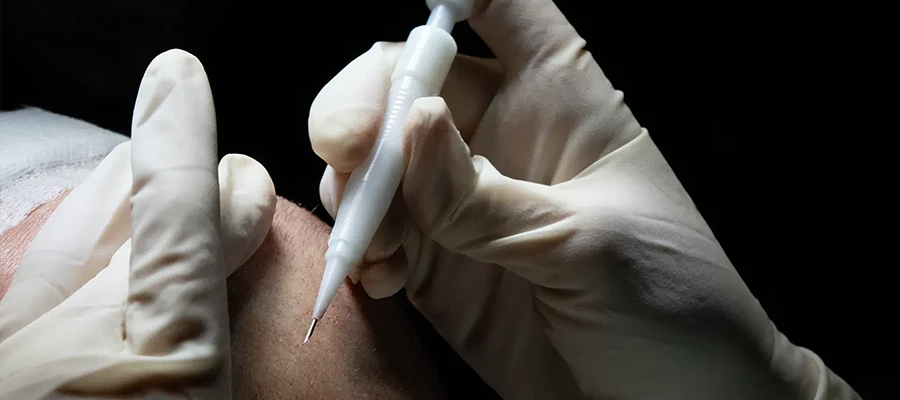
The basic principle of this method is to individually extract hair follicles from the donor area and implant them into sparse or bald areas using special implanter pens. During the procedure, DHI Hair Transplantation differs from other hair transplantation approaches, particularly due to the implanter system used during the graft placement phase.
Root extraction is mostly performed using small-diameter punch instruments, similar to the FUE principle. Therefore, DHI should not be considered a completely different root extraction method. The main difference is usually how the grafts are placed in the recipient area.
Implant pens can help place hair follicles at a specific angle, direction, and depth. However, the natural result is not determined solely by the tool used. Preservation of the donor area, hairline design, correct distribution of grafts, and long-term assessment of existing hair loss also directly affect the outcome.
How is DHI Hair Transplantation Performed?
The procedure begins with the evaluation of donor and recipient areas, planning of the hairline, and administration of local anesthesia. In the next stage, the follicular units required for DHI hair transplantation are individually extracted from safe donor areas, usually located at the back and sides of the head.
The harvested grafts can be separated according to their characteristics and carefully placed into appropriate implanter pens. Then, the roots are transferred to the planned areas with the determined angle, direction, and distribution. In the implanter system, channel creation and graft placement can be performed in stages close together.
Selecting the appropriate grafts is crucial to creating a more natural transition at the front hairline. In areas further back, different distributions can be planned to enhance visual density. The procedure time varies depending on the number of grafts, the size of the transplantation area, and the difficulty of working between existing hairs.
Who is DHI Hair Transplantation Suitable For?
Individuals with permanent hair loss, sufficient donor capacity, and suitable scalp health can be evaluated for this method. DHI Hair Transplantation may be preferred in some cases where controlled graft placement between existing hairs is required, especially when increasing density in specific areas is planned.
Suitability is not solely dependent on the size of the hairless area. The cause of hair loss, the rate of progression, the person’s age, donor density, hair thickness, and expected future hair loss should all be considered together.
Not every type of hair loss is suitable for direct transplantation. In cases of active alopecia areata, some types of scarring alopecia, or uncontrolled scalp diseases, the underlying problem should be investigated first. Insufficient donor capacity can also limit the achievable density.
What are the advantages of DHI Hair Transplantation?
The use of an implanter pen allows for controlled operation of the angle, direction, and position of grafts during placement. When properly planned, DHI Hair Transplantation can help achieve precise placement, especially in areas with sparse existing hair.
In some procedures, the failure to perform a separate, extensive channel creation step in the recipient area beforehand may alter the procedure flow. Additionally, depending on the patient’s anatomy and the planned area, completely unshaven or limited shaved procedures may be possible.
However, the name of the method alone does not guarantee higher density or more natural results. Graft viability, donor area management, hairline design, and the correct determination of implantation directions are of great importance. The technique to be applied must be suitable for the individual’s hair structure and treatment goals.
What are the disadvantages of DHI hair transplantation?
Implant-assisted procedures may require technically meticulous graft preparation and controlled placement. In DHI hair transplantation procedures where high graft numbers are planned, this can contribute to an increase in the total procedure time.
It is important that hair follicles are not damaged during the proper loading of grafts into the implanter pens. The characteristics of the instrument used, as well as the application technique and the condition of the grafts outside of the procedure, can all affect the outcome.
The DHI approach is not expected to be advantageous in every case. In very large areas of hair loss, different placement methods or combined planning may be more appropriate. Furthermore, the technique used cannot change the situation if donor capacity is insufficient. The DHI method does not multiply existing follicles; it only redistributes suitable donor follicles to the areas where they are needed.
In which types of hair loss is DHI hair transplantation preferred?
In some types of hair loss where there is permanent follicle loss and sufficient donor hair, transplantation may be considered. Especially in androgenetic hair loss, DHI hair transplantation can be used to create density in the hairline, temples, or thinning areas.
The implant method may be preferred when controlled placement is needed in areas where existing hair has not been completely lost. However, the choice of technique does not replace diagnosing the cause of hair loss.
Temporary widespread hair loss, such as telogen effluvium, active alopecia areata, and some inflammatory or scarring hair diseases, require different evaluations. It is important to determine whether hair follicles have been permanently lost . Before deciding on a transplant, the type of hair loss and the likelihood of its progression should be clarified as clearly as possible.
How is the donor area determined for DHI hair transplantation?
A safe donor area is selected from a region that is more resistant to hair loss in the long term and has sufficient follicular units. For most people, the back and sides of the head are considered the primary donor sources for DHI hair transplantation.
During the examination, not only the number of roots per square centimeter is considered. Hair thickness, the number of hairs in follicular units, existing miniaturization, and the risk of future hair loss in the area are also taken into account.
Accurately defining the boundaries of the donor area is crucial for long-term outcomes. Hair harvested outside the safe zone may be more prone to future hair loss. Excessive hair removal can also lead to permanent thinning and irregularities in the donor area. Therefore, the goal should be a safe and balanced harvesting of grafts, rather than maximizing the number of grafts.
How is a hair analysis performed before DHI hair transplantation?
The pre-procedure assessment focuses on understanding the cause of hair loss, current density, and donor capacity. Prior to a planned DHI hair transplant, the hairline, the extent of thinning, hair strand characteristics, and the overall condition of the scalp are all examined together.
In the donor area, density, hair thickness, and the structure of follicular units are evaluated, while the location and miniaturization level of existing hair in the recipient area can be considered. The progression of hair loss over time and family history also contribute to long-term planning.
In cases of sudden or widespread hair loss, focusing solely on a transplant plan is not appropriate. Nutritional deficiencies, hormonal causes, telogen effluvium, inflammatory diseases, or different types of alopecia can be investigated. Accurate diagnosis helps avoid unnecessary or ill-timed procedures.
How is the number of grafts calculated before DHI hair transplantation?
The number of grafts required is estimated by considering both the size of the bald or thinning area and the desired visual density. When planning, the amount of grafts needed for DHI hair transplantation is not determined solely by the surface area of the bald area.
The density of existing hair, the thickness of the hair strands, color contrast, and the number of hairs per follicular unit all affect visual coverage. The position of the frontal hairline can also significantly alter the overall requirement.
The calculated number should be compared with donor capacity. The theoretical amount of grafts needed by the recipient area may be higher than what the donor area can safely provide. In such cases, more emphasis may be placed on visually prioritized areas such as the hairline and frontal region . Planning should also include leaving a donor reserve for future hair loss.
How many grafts are needed for DHI hair transplantation?
There is no standard number of grafts that applies to everyone. The number needed during a personalized DHI hair transplant depends on the size of the baldness, existing hair density, hairline design, donor capacity, and the desired coverage.
Limited temporal baldness or a small frontal area may require fewer grafts than extensive frontal and crown hair loss. Additionally, follicular units containing thick and multiple hairs may create a stronger perception of density in some individuals.
Aiming for a high graft count alone is not a measure of success. Overuse of donor space can lead to permanent thinning. Therefore, a long-term balance must be struck between the amount of graft that can be safely harvested and the needs of the recipient area.
How is the hairline designed for DHI hair transplantation?
When creating a natural hairline, facial proportions, the location of existing hair, age, and expected future hair loss are taken into consideration. Instead of lowering the hairline as much as possible during a planned DHI hair transplant, it is important to determine a starting level that will remain natural in the long term.
Using thinner, more suitable grafts in the frontal area can provide a smooth transition. The angles and directions of hair growth should also be planned to be compatible with the existing natural structure.
Perfectly straight and symmetrical lines don’t always reflect the natural hair structure. Small transitions and appropriate irregularities can create a more natural look. A hairline designed too low at a young age may become incompatible with progressing hair loss and unnecessarily deplete future donor reserves.
Is it possible to perform correction procedures after DHI hair transplantation?
If the initial procedure leaves behind insufficient density, an uneven hairline, or localized gaps, a second corrective procedure may be considered for suitable individuals. After sufficient healing is complete, the areas requiring improvement following DHI hair transplantation and the existing donor capacity should be reviewed together.
Correction doesn’t always mean adding more grafts. Issues like an unnatural hairline, misdirected roots, or uneven density may require different planning. Scarring from previous procedures and thinning in the donor area can also affect the new application.
The sparse appearance seen in the early stages should not be considered a direct failure. It can take months for transplanted hair to fall out and regrow. Therefore, planning an early correction without adequately evaluating the final growth may not be appropriate.
Is it possible to have a second DHI hair transplant?
A second procedure may be possible if there are enough hair follicles left in the donor area that can be safely harvested. For individuals who have previously undergone DHI hair transplantation, the suitability of a new procedure is evaluated based on the number of grafts used in the first procedure and the progression of existing hair loss.
The second treatment is sometimes performed to support areas where sufficient density could not be achieved in the first session. New bald patches that develop over time due to ongoing natural hair loss may also necessitate an additional treatment.
It is important to remember that the donor area is limited. If too many grafts are taken during the first procedure, there may not be enough reserve for the second session. Therefore, planning the new grafts not only for existing gaps but also according to expected future hair loss is important for the long-term outcome.
DHI Hair Transplant Prices 2026
Treatment costs can vary depending on the number of grafts needed, the extent of hair loss, the characteristics of the donor area, and the technical scope of the procedure. Therefore, it is not accurate to state a single, universally applicable price for DHI Hair Transplantation in 2026.
Frequently Asked Questions
How long does a DHI hair transplant take?
The total duration varies depending on the number of grafts to be transplanted, the characteristics of the donor area, and the size of the treatment area. A comprehensive DHI hair transplant procedure can take several hours, and the working time may be longer in cases requiring a high number of grafts.
Does DHI hair transplantation hurt?
Local anesthesia is usually administered to minimize discomfort during the procedure. While a brief stinging or burning sensation may be felt during the initial application of anesthesia, the aim is to keep significant pain under control throughout the DHI Hair Transplant procedure.
In DHI hair transplantation, is the hair completely shaved off?
Complete shaving is not mandatory in every procedure. When hair structure, graft requirements, and the working area are suitable, DHI Hair Transplantation can be performed with limited shaving or, in selected cases, with a shave-free approach.
How many grafts can be used with DHI hair transplantation?
There is no universally applicable safe upper limit for the number of grafts that can be transplanted in a single session. The number of grafts required during a planned DHI hair transplant is determined by donor density, hair strand characteristics, the safe harvesting area, and the size of the recipient area.
How many days of rest are needed after a DHI hair transplant?
It is important to protect the transplanted area from physical contact, friction, and strenuous activity for the first few days. The required rest period after DHI hair transplantation may vary depending on the individual’s occupation and the extent of the procedure.
When can I return to work after a DHI hair transplant?
The time to return to work is determined by the physical intensity of the job and the individual’s recovery process. While those who work at a desk may return physically sooner after DHI hair transplantation, visible redness, swelling, or scabbing may persist for a while.